Proactive vs. Reactive: How to Focus on What’s Important
Written by Dave Bailey
Written by Dave Bailey, Apr 07, 2019Audit how you spend your time, consciously prioritise your tasks and get back in control of your to-do lists.
Key Takeaways
- Reactive time is spent on other people’s priorities; proactive time is spent on your own.
- Most founders end up 90% reactive. Aim closer to 50/50.
- Better to-do lists help: next steps, concrete verbs, time estimates, and the 1–3–5 rule.
- Block out at least three hours of uninterrupted proactive time, and coach your team to solve their own problems.
‘I have no time to think strategically.’
‘I feel like I don’t have space to breathe.’
‘I’m totally overwhelmed.’
Even if we aren’t saying it out loud, these are statements that every manager can relate to. Startups are non-stop. Every closet is full of skeletons, waiting to jump out and surprise you.
While we might be tempted to shrug this off as par for the course, the reactive pattern of continuous fire-fighting poses a number of risks for leaders:
- Among the barrage of other people’s priorities, important issues can go unnoticed.
- The overwhelm, stress, and cognitive load has a massive impact on performance.
- Short-term decisions are taken when a long-term solution would be better for the business.
Given the immense challenges involved in starting a new business, how are founders and managers supposed to find time to be more proactive?
Reactive Time vs. Proactive Time
To become less reactive, you have to understand the difference between reactive and proactive time.
Reactive time is spent working on other people’s priorities. Here are some examples:
- Answering emails—your inbox is a long list of other people’s priorities.
- Dealing with inbound issues—when staff, investors and customers come to you with their challenges.
- Attending operational meetings—weekly catch-ups, sales meetings, and other meetings with a fixed agenda.
- Giving one-on-ones—coaching team members to go through their agenda.
- Reviewing work—providing feedback on work and testing new features.
Proactive time is spent working on your own priorities, such as:
- Prioritising your tasks—the process of writing out your to-do list and defining the most important items, especially small problems that are getting bigger.
- Working on important, but not urgent, items—in other words, small problems getting bigger rather than big problems getting smaller.
- Taking time to think—taking a walk outside the office to think through things with a bit of distance.
- Looking after yourself—exercising, spending time with your family, your coach, or even your therapist.
- Reading up—articles and books about something that you want to learn more about.
Understanding the difference between reactive and proactive time was a revelation for me. I was drowning in emails, meetings, and reviewing other people’s work. As I looked through my calendar, I realised that almost 90% of my week was spent on reactive tasks.
The only time I allowed myself to be proactive was at night and on weekends. It was exhausting. Now, don’t get me wrong—my team loved me for being responsive to their needs—but somewhere along the way, my priorities had gotten lost.
How Proactive Should We Be?
Reacting promptly to the unexpected is part of any leader’s job description. But so is being proactive. My meagre 10% of proactive time wasn’t enough for me as the CEO of a startup. So I set myself a new target: 50% reactive and 50% proactive.
While there is no universal ratio of proactive to reactive time, if you’re feeling overwhelmed or stressed, it’s a clear sign that you need to rebalance your time towards being more proactive.
Here are some things that every manager can do to rebalance their routine.
1. Write Better To-Do Lists
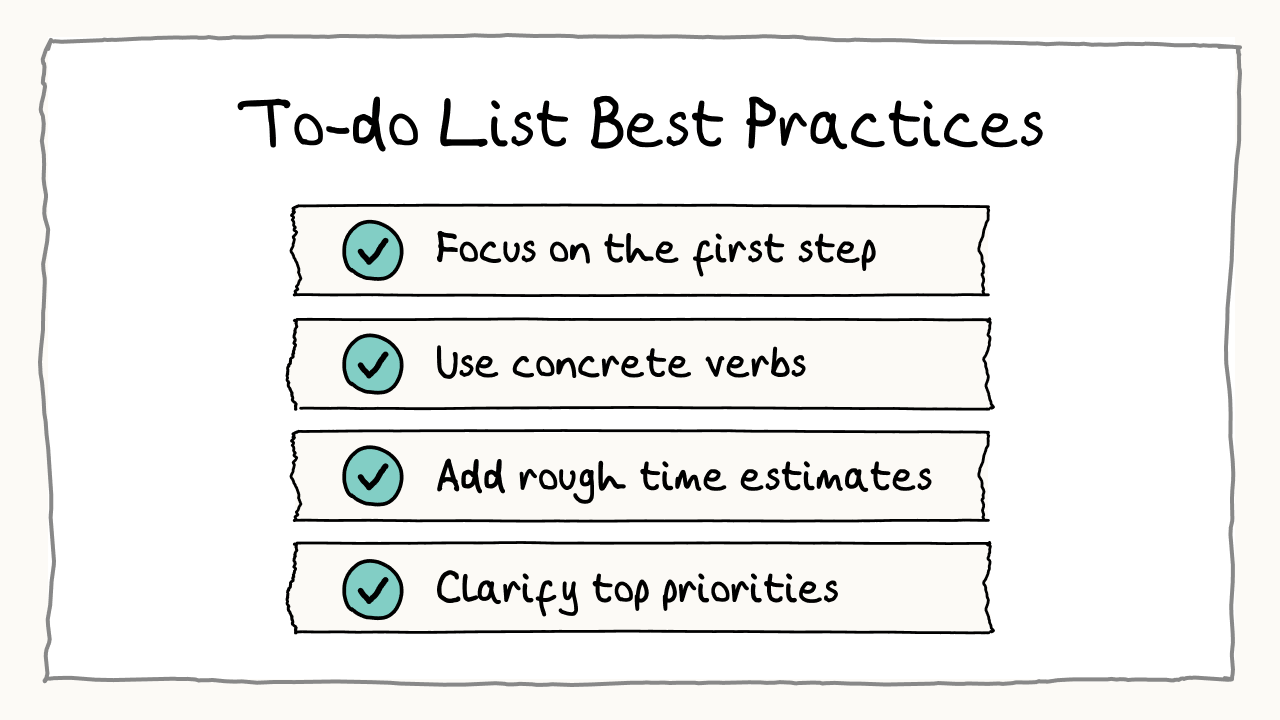
Structuring and prioritising a to-do list can relieve anxiety and help you to refocus on what’s important. However, not all to-do lists are created equal, so here are some ways to improve your to-do lists and make your proactive time as efficient as possible.
Focus on the first step
It’s human nature to procrastinate on big and scary items. So, when you’re faced with a big task, just write down the next step:
- ‘Figure out board presentation’ (big and scary)
vs. - ‘Write 7–10 bullet points to cover in the next board meeting’ (next step)
Use concrete verbs
The more actionable the task, the more likely you are to attack it when the time comes:
- ‘Investor deck’ (unclear action)
vs. - ‘Write answers to these 12 investor deck questions’ (clear action)
Add rough time estimates
This will help you identify short, mechanical tasks that can be actioned between meetings, versus longer, more creative tasks that require a larger chunk of time:
- Email Tom for the financial data (2 minutes—quick and mechanical)
vs. - Add graphics for each slide in the sales deck (1 hour—long and creative)
Clarify your top priorities
Just because it’s on your to-do list doesn’t mean you should do it now. Apply the 1–3–5 rule as a way to de-prioritise less important tasks:
- 1 big thing
- 3 medium things
- 5 small things
2. Build Proactive Time into your Schedule
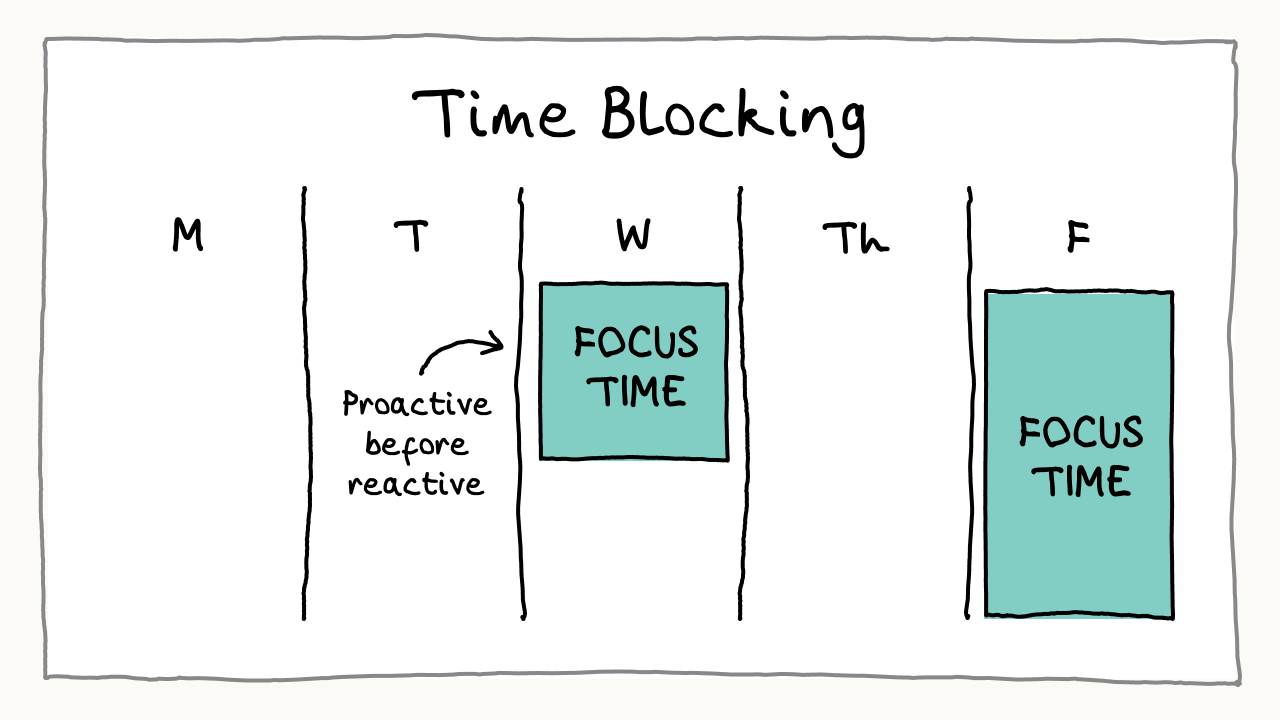
In most cases, securing more proactive time means seizing control of your calendar and blocking time for yourself.
If you don’t actively manage your time, other people will manage it for you.
Some founders pick one or two afternoons per week as ‘no meeting time’. Others reserve time every morning, or block out entire days for this purpose.
Whatever you choose, I recommend building in uninterrupted blocks of at least three hours. Creative tasks don’t fit into hour slots—it can take me an hour or two just to get into the right mindset to tackle something difficult. Paul Graham calls this the difference between the maker’s schedule and the manager’s schedule.
Help me become a better CEO ->
3. Empower Your Team
Managers are natural problem solvers. So when a team member comes to you with a big, juicy problem, it’s tempting to jump in and fix it. And let’s face it, the most tantalising problems to solve are exactly the ones that other people find challenging.
However, if you want to regain control of your time, you have to learn how to empower your team to solve their own problems. Rather than jump into the detail, learn to play the role of coach—ask questions that help your teammates solve their own problems to free up your time.
If you're interested to learn how to coach, check out The Playbook.
4. Hire a Coach
One of the key roles of a coach is to help you take the time to reflect, and follow through, on achieving your goals. Unlike a consultant, a coach doesn’t provide answers. Instead, they ask questions that help you clarify what needs to be done and then help you hold your agenda.
Coaching sessions are pure proactive time. This is why the one-on-ones that you have with your team aren’t proactive for you, but they should be proactive time for them. Likewise, the boss needs one-on-ones too.
Be Proactive About Being Proactive
If you’re spending too much time in the weeds, then it’s not a lack of time, it’s a lack of prioritisation.
Clarify your priorities, schedule in proactive time, empower your team, and hire a coach. There’s no need to feel guilty about it. After all, if you don’t look after your own priorities, who will?
Continue reading about being proactive:
- Recently expanded your managerial team? Here’s a handy guide on how to train new managers.
- Struggling to get your tasks done? Read my guide and learn how to stop procrastinating.
- Starting a coaching business? Learn this tried and tested way to coach startup founders.
Join my $100M CEO newsletter ->
Originally published Apr 7, 2019, last updated Jul 19, 2026.