The First Step Towards Getting Acquired
Written by Dave Bailey
Written by Dave Bailey, Aug 05, 2026
This guide breaks down how to get your company bought: a stage-by-stage playbook for creating a buyer who pursues a Big Idea only your startup can make real.
Key Takeaways
- Aim to get your company bought, not sold, by creating a buyer before running a sale process.
- The biggest offers come when a buyer pursues a Big Idea that only your startup can make happen.
- Start early, identify potential buyers, and help each one arrive at their own Big Idea.
- Work through four stages with the buyer, from defining the opportunity to evaluating the economics.
- Focus on the buyer’s valuation and multiple, so their first offer is a great one.
Last year, five of the CEOs I coach got acquired by big companies.
Most founders think acquisitions begin when they decide to sell. Their mental model is something like this:
- Prepare the business for a sale.
- Hire a banker to run a process.
- Sell to the highest bidder.
And while this can work, it’s not what I see the best CEOs doing. At least, it’s not the whole story.
The biggest acquisitions happen when the right buyer is pursuing a Big Idea and sees buying your startup as the only way to make that idea happen.
You want your startup to be bought, not sold.
Shifting your mindset from selling up to creating a buyer could be the most valuable shift you ever make.
Here’s how to do it.
The Magic Box Paradigm
In the book, The Magic Box Paradigm, Ezra Roizen says buying a startup isn’t like buying a commodity. It’s more like buying a Magic Box.
A popsicle is a commodity. You know what a popsicle does: it refreshes you on a hot day. And while you might pay a premium if someone offers to deliver one to you on the beach, its price falls within a predictable range.
A Magic Box is different.
What’s inside the Magic Box is different for every buyer. There might be 100 gold coins, or just three silver coins, or even a lump of old coal. You don’t know what’s inside until you open it.
And there’s another catch. The only way to unlock the Magic Box is to climb a treacherous mountain, with the original seller, and open it together.
The decision to buy a Magic Box relies on two underlying beliefs:
- Belief 1: There is massive value inside the box for me.
- Belief 2: The original seller and I can climb the mountain to unlock it.
Startups are Magic Boxes.
The value of a startup is different for every buyer.
And the buyer can only realise that value by working with the founders and team for many years after the purchase.
The question is: can you create these beliefs in a potential buyer?
Yes, it is possible. But it takes time.
That’s why it’s best to start the process long before you intend to sell.
Your mission is to identify potential buyers, and then help them each come up with their own Big Idea that you are uniquely placed to unlock.
The Buyer’s Big Idea
In order for a buyer to make you a big offer, they need an even bigger idea.
It’s an idea about how to generate significant enterprise value that justifies making you a big offer.
And it has to be their idea, not yours.
This is fundamentally different to pitching an investor. Investors don’t need to think it’s their idea because they don’t have to execute on it.
But the buyer does.
When it’s their idea, they become committed enough to put in the energy, time and resources to endure the difficult process of aligning internally, acquiring the company, integrating it, retaining the team, and explaining it to the market.
Your job is to help them come up with the Big Idea.
As I’ll show you, the best time to do this is long before you intend to sell.
In fact, this is something you should probably start on right now.
Big Ideas happen in four stages:
- Defining the opportunity
- Aligning the method
- Planning the execution
- Evaluating the economics
At each stage, I outline three things you can do to help the Big Idea emerge and take shape.
Help me become a better CEO ->
Stage 1: Defining the Opportunity
Every Big Idea is built on an opportunity to create value.
Examples of Big Ideas include entering an emerging market category with high growth potential, and leveraging a new technical capability to supercharge an existing market.
Here’s how to help at this stage.
(i) Engage in Partnership Conversations.
The ideal context for Big Ideas to emerge isn’t a pressured sale. It’s an exciting partnership.
That’s why many big offers start with partnership conversations.
You get to learn about them: their challenges and opportunities, their language and ways of working, and who’s who.
Even more importantly, they get to learn about you: what you actually do, where you can add value, and what it’s like to work with you.
It’s not particularly important that the partnership is big, or even that the partnership actually happens. What matters are the conversations.
For example, a particular partnership may be too difficult, either technically or legally, to pull off as separate entities. This could even make a stronger case for acquisition later on.
(ii) Build Relationships with the Right People.
The partnership conversations might not be with the right people, and that’s ok. Use your counterpart to learn who the right people are.
There are three profiles you want to get in front of:
- Product leaders: Particularly in the case of tech companies, product leaders play a critical role in acquisitions. They’re often looking for ways to meet increasing growth targets. Product leaders often have the vision, technical knowledge, and growth imperative to come up with Big Ideas, and they’ll be highly involved in making the Big Idea real.
- The CEO and senior leadership: The CEO and C-suite are charged with the strategic direction of the company. If the company is pre-IPO, they are thinking about the IPO story. If the company is public, they are thinking about ways to increase the stock price.
- Corporate development: This is the function that will run the M&A and legal processes. While they don’t have the power to drive ideas through, they are critical to getting the deal done, so it’s important to get them onside.
Smart CEOs build relationships in two ways.
The first is by meeting people in person, adding value where possible, often by sharing insights, and following up.
The second is by being a thought leader in your industry and building a stellar reputation. You do this by speaking at events, posting on social media, and getting cited in the press.
Thought leadership is a great way to build multiple relationships all at once. That way, when you meet with the right people, they already know you and what you stand for.
(iii) Lead Every Meeting with Your Mission and Vision.
This is so simple you might forget to do it.
However, I recommend leading every single meeting with your mission and your vision for the future, not your product.
You want to drill this into their minds. When you do this repeatedly, they’ll start to buy into it. And when that happens, they’ll connect the dots for you.
Share your ideas about where the market and industry are going, the potential for the product category or technology, and what this could mean for their business.
Talk as peers, not as a salesperson.
Ask how these market forces will impact them, and what the winning market position will be in the future.
When the Big Idea emerges from a shared vision, it puts you in a great position.
Stage 2: Aligning the Method
A shared vision of the opportunity isn’t enough. As Chris Voss says, “What is nothing without how.”
The buyer will need to figure out how the Big Idea fits with their existing business. They also need to visualise how you would fit in.
The buyer will have a tried-and-tested way of doing things, as well as values and principles they hold sacred. Some buyers may be open to doing it your way, but it’s best when it’s a blend of both.
Here’s how to help at this stage.
(i) Jump on a Plane.
If you haven’t already, once an opportunity starts to take shape, you want to double-down on in-person meetings with key stakeholders.
When it comes to building relationships, in-person is far better. Moreover, you’ll get a huge amount of intel about how they work.
“I happen to be in town on the week of X. Would you like to meet in person?”
You might also invite them to visit you at your offices if they happen to be in town. Be sure to position this as a commercial partnership with the team. You don’t want to start a rumour mill, because you don’t want even a whiff of a sale.
(ii) Assess Them for Alignment First.
The job isn’t to fake alignment; it’s to establish whether there is alignment.
Don’t try to impress. Try to assess.
Take it upon yourself to learn as much as you can about their business. The more you know, the more you can evaluate if the opportunity is a match. Ask questions like:
- How would this opportunity fit with their current product set?
- Which of their existing distribution channels could support the GTM?
- What is the buyer’s brand message and how does it align with yours?
- What is the long-time market position the buyer is trying to take?
- How do their values and company culture compare with yours?
Taking the onus of figuring out alignment gives you the upper hand. And where you find alignment, make sure they can see it too.
(iii) Communicate Your Ideas in Their Language.
Every buyer has their own internal language and this creates an insider-outsider dynamic.
To learn their language, listen out for unique or unusual terms, ask what they mean, and then use them in the appropriate context.
The more you talk and think like them, the easier it’ll be for them to visualise you as a potential leader in their company.
Stage 3: Planning the Execution
Only when the opportunity is clear and the methodology is aligned should the conversation progress to execution.
The value often lies in leveraging the strengths of each party. Often the startup will be particularly strong in product, while the buyer will be stronger in distribution and monetisation.
This is the plan to get up the mountain together.
Here’s how to help at this stage.
(i) Emphasise Your Uniqueness.
You want them to believe you are critical to realising the Big Idea, and that they can’t do it without you.
That’s why you need to position what you’ve built and the capabilities you bring to the table as one-of-a-kind.
One of the unique things most CEOs overlook is their relationship with the buyer.
For example, if you spend more time with the buyer than other companies, this makes you a known quantity. That might be enough to make you unique compared to other companies they know less well, or have known for a shorter period of time.
This is another reason why it’s helpful to start these conversations sooner rather than later.
(ii) Make Sure You Come Off as Highly Competent.
During this phase, you’ll meet more of the buyer’s team, and you will solve problems together.
Are you easy to work with? Do you come prepared? Do you take on a lot of the work, with a smile, and get it done quickly?
This is their test drive to learn what it’s like to work with you, and your opportunity to stand out as an A+ player.
(iii) Facilitate the Process.
Getting anything done in a big company is hard. Even aligning schedules can be a challenge.
You want to facilitate the process, which means making it easy for everyone involved.
A great facilitator prepares so the meetings are structured and helpful. They mediate hard conversations between stakeholders. And they ensure momentum is high and people leave meetings excited about their next steps.
If you have a champion, make their life easier. In fact, make everyone’s life easier. That will build you a lot of goodwill.
Join my 11,000+ CEO readers ->
Stage 4: Evaluating the Economics
Now it’s time to quantify the value of the Big Idea. This includes the potential upside and the costs to achieve it.
If you’ve done Stage 3 right, you’ve positioned yourself and your business as critical for the Big Idea to happen. This means the value of their offer will be framed by the value created by the Big Idea.
Here’s how to help at this stage.
(i) Focus on Their Value, Not Yours.
When you are selling your company, you frame the purchase in terms of maximising your valuation.
When a company is buying you, they frame the purchase in terms of maximising their valuation.
Many CEOs fall into the trap of allowing the conversation to focus on their standalone valuation. However, this is often far smaller than the buyer is willing to pay to realise their Big Idea.
Your primary concern isn’t valuing your company. It’s helping them assess and feel confident about the value of the Big Idea.
(ii) Create a Two Line Model.
Ezra Roizen came up with a great way to visualise the value of an acquisition called the Two Line Model.
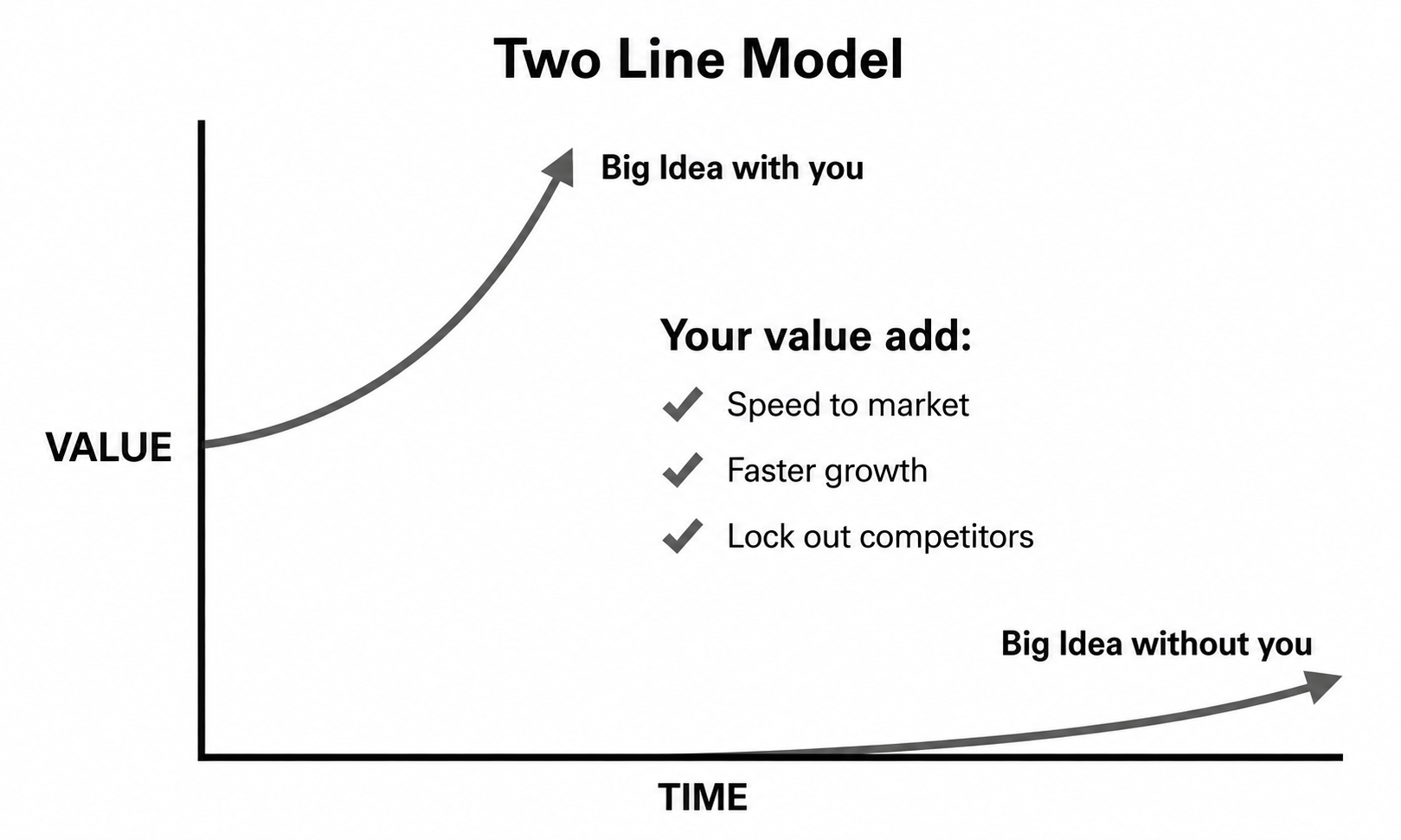
The first line shows what their company is worth if they pursue the Big Idea with you.
The second line shows what their company is worth if they pursue it without you or fail to execute on it.
The space between the lines is the value you create. This provides an easy way to visualise the value of being faster to market and compounding growth.
Even if these numbers are hard to quantify, just sketching this model on a piece of paper or an iPad can have a powerful psychological effect on the buyer.
(iii) Point to a Bigger Multiple.
The ultimate goal is to link the Big Idea to enterprise value. The best acquisitions don’t just add revenue. They change the story the buyer presents to the market.
So what drives the valuation of bigger companies?
A helpful formula to analyse is:
Enterprise Value = Revenue * Multiple
Helping a company increase their revenue plays an important role in enterprise value. But an even bigger impact comes from the multiple.
A multiple is based on the story investors tell about the buyer: how big they can become, how fast they can grow, and whether they’re positioned to win in the marketplace.
If you can help a company increase their multiple, you can create a lot of value for the buyer.
Multiples typically fall into a range based on the buyer’s industry. The companies that command the highest multiple tend to:
- Be the biggest. Market leaders tend to capture the lion’s share of the returns in any industry.
- Have better growth prospects. They are placed to win emerging categories set to become big markets.
- Be seen as tech-forward or tech-enabled. All things being equal, tech companies and those leveraging AI tend to command higher multiples.
Even if they think you are crazy, it’s very helpful to seed the idea of a target multiple in their minds. Enterprise value is their single biggest incentive.
If you can do this, you maximise their value estimate which will in turn maximise the offer they are willing to give you.
The Turning Point
Up to this point, you haven’t been selling your company. You’ve been helping the buyer build conviction in a Big Idea.
If you’ve done that well, the conversation naturally shifts from “could we partner?” to “do we need to own this?”
That’s when a buyer asks a specific question:
“What do you guys really want?”
This is a more important question than it looks.
You can’t say, “we want to sell,” or you’ll put yourself in the seller position and lose power in the negotiation.
There’s a better answer.
“We want impact.”
You are mission-driven and open to whatever it takes to maximise your impact. If that’s best achieved independently, we’ll do that. If it’s best achieved through partnership, we’re open to it. And if it’s best achieved together, inside your company, we’d be open to that too.
Impact signals to the buyer the economics of the Big Idea matter. If the Big Idea doesn’t have a big impact, it’s not interesting. If you aren’t essential to the Big Idea, that’s not interesting either.
And big impact commands a big offer.
Getting the First Offer
Because this is about getting bought, not selling through a process, it is hard to time the offer and get multiple potential buyers to make offers at the same time.
That’s why you want their first offer to be a great offer.
If you were to propose or anchor a price, you might go wildly under and leave money on the table. Or you might go wildly over and kill the conversation.
But by this point, you’ve already done the work.
You’ve helped them quantify the Big Idea. You’ve established yourself as the scarce path to achieving it. And you’ve let them arrive at the conclusion themselves.
What happens after the offer is the subject of another essay.
But if a buyer comes to you with a serious offer, without you ever putting yourself up for sale, you’ve achieved the goal.
Continue Learning About Startup Acquisitions
More on acquisitions, valuations, and negotiation:
- Six Ways Acquirers Value Your Company
- How to Avoid Common Acquihire Mistakes
- How to Win a High Stakes Negotiation
Join my $100M CEO newsletter ->
Originally published August 5, 2026.